

One workflow. Clear diagnosis. Practical fixes.
We offer a practical business process improvement service for small and growing UK teams. We examine one recurring workflow, map what happens in practice and identify the changes most likely to reduce delays, duplicated effort and operational risk.
You’ll receive a clear picture of what’s going wrong, what matters most and what to change first.
Is a Workflow Audit right for you?
A Workflow Audit is useful when you know a recurring process is not working as well as it should, but the underlying cause or best solution is still unclear.
You might be experiencing:
projects repeatedly stalling at the same stage;
people chasing information before they can continue;
inconsistent or unreliable handovers;
unclear responsibilities or approval decisions;
information being copied between different tools;
work relying too heavily on one person’s memory;
unofficial spreadsheets and workarounds becoming part of the process; or
systems that no longer support how the business operates.
You may already have tried introducing a new tool, template or checklist without fixing the underlying problem.

How the audit works
The audit focuses on one recurring workflow with an agreed starting point, endpoint and intended outcome.
This could include:
turning an agreed sale into a ready-to-start project;
managing approvals across several people;
handing work between teams;
processing orders, requests or applications;
managing changes to project scope or budgets;
producing recurring reports or client deliverables; or
another repeatable process involving several stages, people or systems.
You do not need to have mapped the workflow beforehand. Part of the audit is reconstructing what actually happens in practice.
-
We agree where the workflow starts and ends, what it should achieve and what problems you are currently seeing.
-
We review your written input and recent examples to understand how information, decisions and work move between people and systems.
-
We look for unclear ownership, missing information, weak handovers, duplicated work, unnecessary approvals, hidden workarounds and recurring exceptions.
-
The findings are turned into focused recommendations, prioritised by their likely impact and the effort required.

What is included
The standard Workflow Audit includes:
one structured leadership questionnaire
review of any relevant documents, screenshots or completed examples
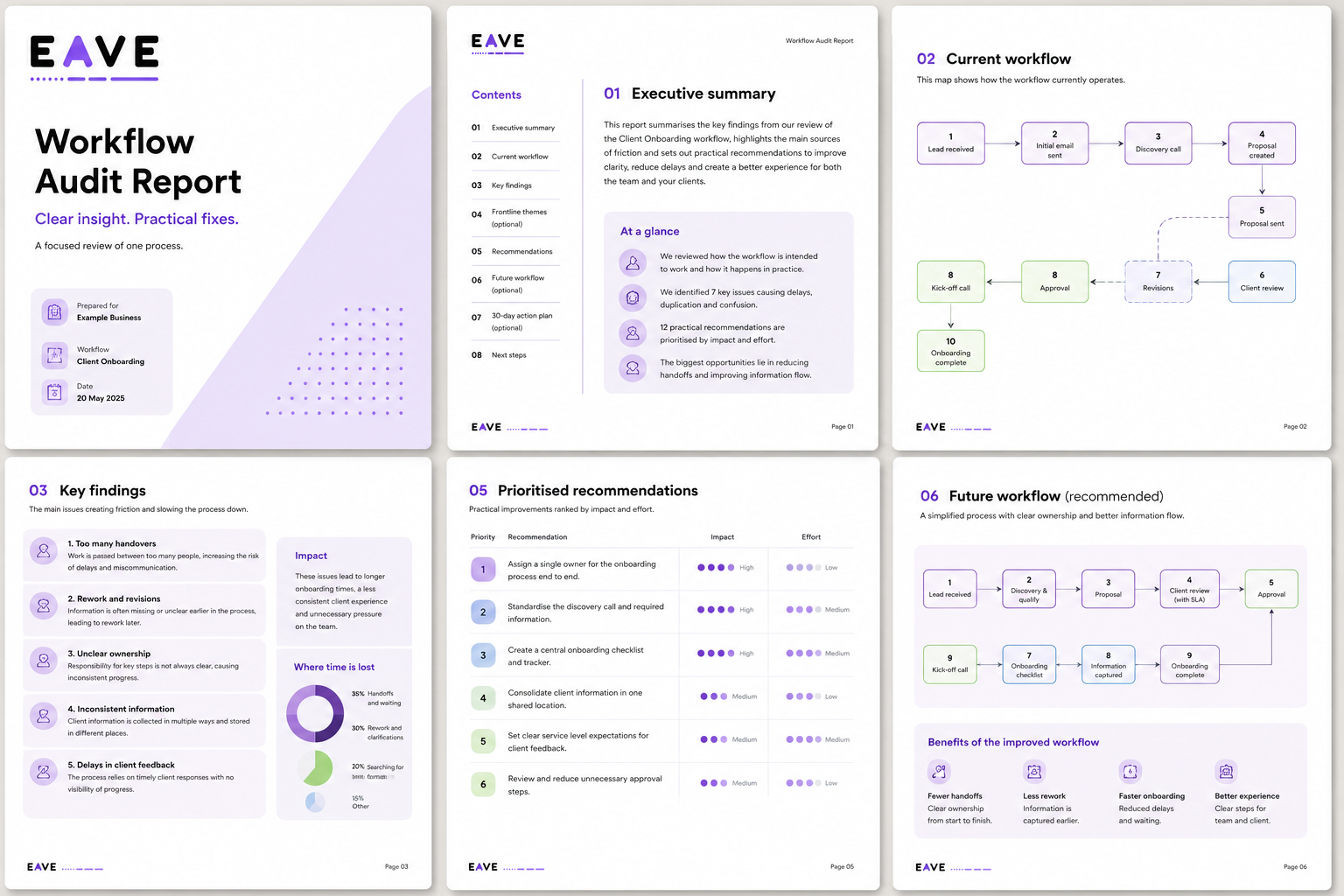
a current-state workflow map
a list of the key findings
the evidence and likely causes behind each finding
prioritised recommendations
a concise written audit report
one consolidated round of questions and factual corrections
If the workflow cannot be properly assessed within these limits, I will explain what additional evidence or work would be needed before you commit to anything.
What you’ll receive
Your audit is tailored to the workflow and the level of investigation required.
Current workflow map
A clear visual showing how work currently moves between people, tools and decision points.
Core Audit:
Key findings
The most important sources of delay, duplication, confusion and operational risk.
Prioritised recommendations
Practical improvements organised by likely impact, urgency and effort.
Written findings report
A clear explanation of what is happening, why it matters and what should be addressed first.
The people doing the work usually know what’s broken
Leadership often sees the outcome of a process problem: missed deadlines, inconsistent quality, frustrated staff or unhappy clients.
The people completing the work usually know where the problem begins.
Where Team Insight is included, Eave gathers confidential frontline input as part of the audit. Individual comments are not attributed by name, and findings are reported as combined themes wherever possible.
In very small teams, complete anonymity cannot always be guaranteed because certain responsibilities may belong to only one person. We will always explain this clearly and avoid using identifiable comments unnecessarily.
The purpose is not to assign blame.
It is to create enough safety for people to explain what is really happening.


Designed to be async-first
The audit can be completed primarily through:
structured questionnaires
written follow-up questions
document and tool reviews
screenshots
screen recordings
email or secure online messages
This allows people to contribute around their existing workload without arranging a series of disruptive meetings.
Calls, interviews and findings sessions are available where they would genuinely improve the work, but they are not automatically required.
What happens afterwards?
The core audit gives you a clear diagnosis and practical recommendations that your team can implement internally.
Where additional support is useful, Eave can also help with:
designing the improved workflow
creating templates and checklists
documenting standard operating procedures
configuring existing tools
introducing sensible automation
designing AI-assisted workflows with human review
testing the new process
gathering feedback after a pilot
refining the workflow before wider rollout
Any implementation work is scoped separately. You are not committing to a large transformation programme simply by commissioning an audit.

Choose the level of support you need
Core Workflow Audit
Establish how the workflow operates, where the most important friction sits and what should change first.
Includes:
leadership questionnaire
document and example review
current workflow map
key findings
prioritised recommendations
written report
Typical timescale: 7 to 10 working days
Founding-client rate: from £600
Future Workflow Add-on
Turn the audit recommendations into a practical future workflow, including:
proposed future-state workflow
ownership and responsibility recommendations
implementation priorities
optional 30-day action plan
A findings session can also be included where useful.
Typical price: £300 to £650
Team Insight Add-on
We gather confidential written input from the people carrying out the work and report the findings as combined themes.
This is useful when leadership only sees part of the workflow, different teams experience it differently or the process depends on unofficial workarounds.
The number of contributors, confidentiality arrangements and practical limits of anonymity are agreed in advance.
Typical price: £400 to £900
Implementation Support
Best when you want help putting the recommendations into practice.
This may include templates, documentation, tool configuration, automation, pilot support and refinement.
Typical timescale: 1 to 3 weeks
Typical price: £750 to £2,500
If you are unsure whether the problem needs an audit
Apply for the complimentary Workflow Friction Check.
This is a small, application-only review based on the information you submit. It provides an initial perspective on the problem, but it does not include evidence review, workflow mapping or verified findings.
Get in touch and we’ll see if we can help
hello@witheave.co.uk
FAQs
Do we need a call?
1
Not necessarily. The core audit can be completed using structured written input and document review. A short scoping call can be arranged if it would help define the workflow properly.
Is staff input included?
2
It is available as an optional addition. It is particularly useful when several people carry out the process or when management and frontline experiences may differ.
Do staff have to attend meetings?
3
No. Written questionnaires and recorded walkthroughs can be used instead.
Can you design the improved workflow?
4
Yes. A future-state workflow and implementation roadmap can be added to the audit.
How long does it take?
5
A focused core audit will usually take around one to two weeks once the required information has been provided. Audits involving several team members or more detailed future-state design may take longer.
Who is the workflow audit for?
6
The Workflow Audit is best suited to:
small and growing businesses
agencies and consultancies
research and insight teams
marketing and digital teams
organisations where knowledge is spread across several people or tools
teams that know something is inefficient but cannot agree on the cause
It works best when there is one identifiable workflow or operational area causing recurring difficulty.
When may it not be the right fit?
7
The audit may not be appropriate when:
the issue requires legal, financial, cybersecurity or regulatory expertise
the organisation wants an immediate company-wide transformation
there is no access to the documents or people involved
the problem has already been diagnosed and only specialist technical implementation is required
leadership is unwilling to consider evidence that challenges the current process
Where something falls outside Eave’s expertise, we’ll say so.